
I was young, I trained every day, I had been dancing since I was a child, and structurally speaking, my spine was young and healthy.
But I had developed a significant loss of the natural curves in my spine, probably also related to years of dance and training, and it was causing problems. Eventually, a nerve became involved and my movement became limited.
Many years later, around the age of 30 and after the birth of my daughter, my relationship with movement had changed. I was training less, I had even stopped practising yoga for a while, and my back had started seizing up frequently.
That was when I discovered I had three lumbar disc protrusions.
With the diagnosis came fear.
Be careful. Don’t ride a scooter. Don’t twist. Don’t do this. Don’t do that.
Little by little, I started defining the condition of my back by what I had read in a medical report. Inevitably, I also started moving like someone who was afraid of her own back.
I was told to go swimming. Swimming may well have been helpful, but over time I realised that my body needed more than that. It needed strength. It needed muscles capable of supporting my spine. It needed movement and, perhaps most importantly, it needed to learn to trust movement again.
I started strength training to build the muscles that support my spine. I worked on mobility and, as far as possible in my particular case, on restoring more of the natural curves of my spine.
But the most significant change has happened over the last six years.
And it isn’t only about the way I train.
It’s about the way I live.
For most of my life, I was the one who held everything together
I have always been seen as a strong, grounded, resilient woman. Brave, perhaps even a little reckless in a good way, because I have always had a certain willingness to take risks and step into the unknown.
I recognise myself in that description.
I was never afraid to leave on my own, move to another country and build a new life. When I lived in England, I would apply for jobs that required more experience than I had, simply because I wanted to understand how those interviews worked and get better at them. I would go to parties or dinners where the only person I knew was the host. Of course I could feel awkward, but somehow I enjoyed that feeling too.
Looking back, though, I can see another thread running through my life.
Wherever I went, I somehow ended up having someone to look after.
It had started much earlier. When I lived at home with my father and siblings, my sisters and I shared responsibility for looking after our younger brothers and helping to run the household.
That pattern stayed with me for many years.
I looked after people. I worried about them. I tried to help them, sometimes probably even when they didn’t really need my help.
There was something very strong inside me that said: I can help you. I have to help you.
When I couldn’t, I could even end up feeling guilty.
I don’t feel that need anymore.
There is still someone in my life who genuinely needs my care. My husband is very unwell and, because of both his illness and the language barrier, he is not fully independent in the country where we live. On top of that, there is significant financial uncertainty and a life that has inevitably lost some of the freedom I had managed to regain in previous years.
My life isn’t easier now.
But I am different.
Something has profoundly changed over the last six years in the way I relate to caring for other people.
I no longer feel that I have to constantly take care of others in order to be useful. That doesn’t mean I no longer enjoy caring for people. Quite the opposite. It remains an important part of who I am, and it is probably reflected in the work I have chosen to do: I teach yoga, breathwork, movement and body awareness. I try to give people tools that can help them feel better.
What has changed is where I start.
Today I know that I have to be well first.
I take much better care of myself. I respect my own time and make space for myself. Not because I want to be less available to other people, but because I have understood that this is the only way I can truly be there for them without exhausting myself.
I still care for others.
But now it is a choice.
Learning to take care of myself hasn’t made me less capable of caring for other people. It has made me more capable of doing so without losing myself in the process.
Then I looked at my spine
At this particular point in my life, I discovered that I have significant osteoporosis.
For a few months I had also been noticing a mild ache on the left side of my back. Nothing I would describe as real pain. I assumed it was muscular tension.
During a follow-up appointment, and because after the osteoporosis diagnosis I wanted to understand the condition of my spine more clearly, my orthopaedic specialist prescribed an MRI.
The report contained far more than I had expected.
Disc protrusions at several levels of my spine. Changes in my thoracic spine that I had never imagined were there. A herniated disc. Dehydrated intervertebral discs and other degenerative changes.
Read like that, it sounds like the description of a back in pretty bad shape.
My first association was inevitably with my life.
For so many years, I was the person who supported others, who held things together, who took care of people, who carried the weight. Now I discover that the very structure that literally supports me carries the marks of time.
I have no way of knowing how much my life story has actually affected my spine, and I don’t want to turn a personal reflection into a medical explanation.
But as a metaphor for my life, it affects me deeply.
If I step back and look at myself almost as if I were looking at another woman, I see someone who is still holding an enormous number of things together. At the same time, I discover that, on paper, the structure supporting her appears fragile.
And this is where the story becomes much more interesting.
Because that back is mine.
And it is the same back that now allows me to do things I couldn’t do when I was 30.
When my back looked healthier, I felt worse
This is perhaps the paradox that interests me most.
At 30, I had three disc protrusions and my back would seize up constantly. I was in pain, I had symptoms, and that was precisely why I had the tests in the first place.
Today, what the scans show appears considerably more complex.
And yet I feel so much better.
I’m not saying that I am completely symptom-free. Sometimes I notice an ache or other sensations. Occasionally I have muscular tension. I teach a lot, and like anyone else I can sometimes move without having warmed up properly or do something with less attention than I should.
But fundamentally, I feel well.
I move well. I am strong. I have good mobility. I practise yoga, I do backbends, I work on hip mobility, I hang, I do pull-ups, suspension work and inversions. I work with my body every day.
Most importantly, I don’t live in pain.
I feel much better than I did at 30, and I believe I feel better than I did ten years ago too.
So what does pain actually tell us?
My own experience has forced me to ask that question.
My back was already seizing up when I was 19, before the disc protrusions that would later be diagnosed. At 30, I had three protrusions and I was struggling. Today, my medical report describes a spine that appears more compromised, yet I am far more functional and I am not living with that pain.
For me, this means at least one thing: the pain we experience cannot be understood simply by reading a scan report.
Medical imaging describes structures.
On its own, it cannot tell us how much pain we experience, how strong we are, how mobile we are, what we are capable of doing or what it actually feels like to live in that body every day.
If I hadn’t had that MRI
There is one thought I keep coming back to.
If I hadn’t had that MRI, I would probably have moved exactly the same way the following day as I had the day before.
My body wouldn’t have changed.
Only what I knew about my body would have changed.
I cannot know for certain how long some of the changes I can see today have been there, or how they may have evolved over the years. Some areas of my spine had never previously been specifically investigated with an MRI.
But I can observe something very concrete: how my body functions today.
And that leads to a question that I think goes far beyond my own story.
How much do we allow the words we read in a medical report to change the way we perceive ourselves?
Because knowledge matters.
Knowing that I have significant osteoporosis changes some of the choices I make. Knowing that I have disc protrusions, a herniated disc and degenerative changes is information I need to have, and information I want to explore further with doctors and physiotherapists.
Precisely because I teach movement, I want to understand my spine even better. I want to know how to support it, which movements are appropriate for me, whether anything needs to be modified and where I may need to be more careful.
Awareness does not mean ignoring a diagnosis.
But there is an enormous difference between knowing that you have a condition and allowing that condition to define you.
When a medical report becomes fear
I know the other side of this because I have lived it.
Be careful.
Don’t twist.
Don’t ride a scooter.
Don’t do this.
Don’t do that.
At 30, those words had started to change the way I perceived my back.
Sometimes all it takes is reading words such as “protrusion”, “herniation”, “degeneration” or “dehydration” for us to suddenly start seeing our bodies as fragile.
We begin to avoid things.
I won’t bend. I won’t twist. I won’t lift. I won’t try.
Little by little, our world of movement can become smaller and smaller.
That doesn’t mean we should simply do the opposite.
The point isn’t: “I have disc protrusions, so I can do anything.”
Nor is it: “I have disc protrusions, so I can’t do anything anymore.”
For me, it is more like this: “I have disc protrusions. Now I know they are there. I will assess them with people who have the expertise to do so, listen to the signals my body gives me, and work out how I can continue moving in the best and safest way possible.”
We shouldn’t ignore pain. We shouldn’t continue doing something that causes symptoms simply because we believe being strong or trusting our body will somehow be enough. Nor should we replace medical expertise with our own judgement.
But alongside the information contained in our tests and scans, there is another essential source of information.
Our lived experience of the body.
How do I move?
How does my body respond to a particular movement?
Am I in pain?
Have I lost strength?
Do I have neurological symptoms?
Which movements make me feel better?
Which ones require more attention?
What am I actually able to do today?
What I have learned over the last six years
The way I train has changed completely.
Today, when I do an exercise, the first thing I think about isn’t the exercise itself.
I think about how my body is doing.
How do I feel today? Where do I feel freedom? Where do I feel resistance? Is something asking for my attention? Can I continue? Do I need to modify something?
That is where I start.
Yoga, strength work, mobility, pull-ups, suspension work, inversions: movement has become, first and foremost, a way of developing body awareness.
Other things have changed too. My diet changed, initially partly because I wanted to support my husband during his illness. The way I think about hydration and, more broadly, the way I take care of my body have changed as well.
Perhaps this is the deepest connection I see between my life and my back.
For many years, I didn’t really know how to take care of myself.
I knew how to take care of other people.
Perhaps, at certain points in my life, taking care of others was even a way of hoping that someone would eventually do the same for me. I cannot know for certain whether that was really what was happening, but today I am at least able to ask myself the question.
I don’t feel that need anymore.
I take care of myself because I have understood that this body is not something that should simply keep carrying everything I ask it to carry.
It is the body I have to live in.
In the end, what does it mean to be well?
I think this has become the most important question.
Why do we take care of our bodies?
So that we can continue to live.
So that, for as long as possible, we can preserve our function, our independence, our ability to move, to do the things we love and to live well.
That is why, paradoxically, I don’t see my MRI report simply as bad news.
I have more information now.
I can investigate it. I can seek professional guidance. I can understand how to support my spine more effectively and how I might prevent or slow further deterioration.
In some ways, I can become my own case study.
Not to prove that a particular diagnosis means you can do whatever you want. That would simply be the opposite mistake.
What interests me is something else.
How can I preserve my function?
Where possible, how can I improve it?
How can I continue moving while respecting both what my body is telling me and what I know about its structure?
How can I grow older while maintaining a good quality of life?
For me, that is the point.
Our goal cannot be to have the same MRI at 60 that we had at 20.
Our goal should be to reach our 60s, 70s, 80s and beyond while preserving, as far as possible, our ability to live fully in our bodies.
To understand how they change. To respect genuine limitations when they exist. To adapt when necessary. To seek professional support when we need it.
But to keep using them.
Perhaps the thing that strikes me most when I look at my own story is that now, when my physical structure appears more fragile on paper, I actually feel much stronger in the way I live my life.
Not because I am capable of carrying more.
Perhaps because I have finally stopped believing that being strong means carrying everything.
I have learned to take care of myself.
I have learned to listen to my body before asking something of it.
I have learned that knowing a limitation exists does not automatically mean being afraid of it.
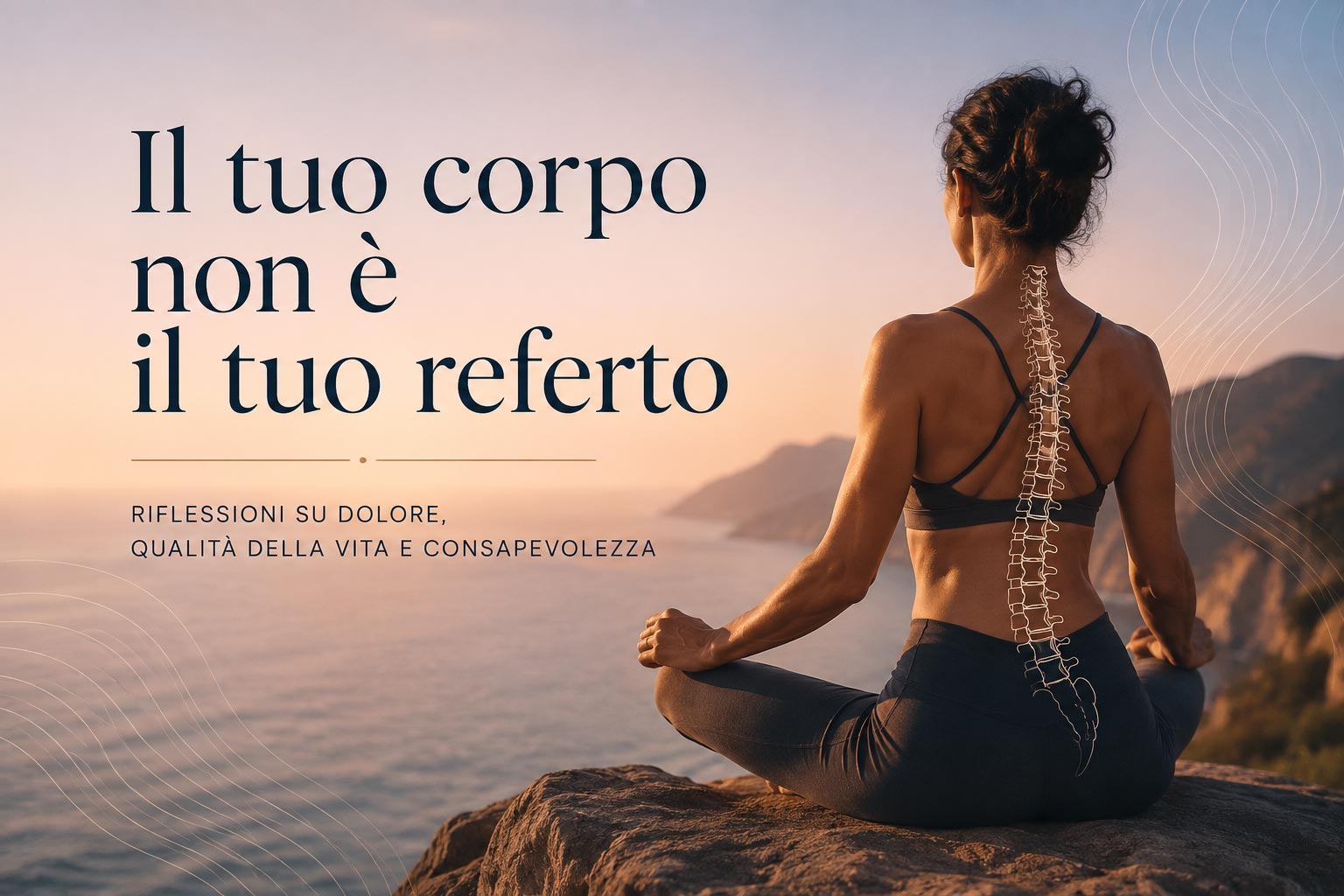
An image tells us something about structure.
But on its own, it cannot tell us how we are.
A medical report is one part of the story.
Pain is another.
Strength, mobility, function, our everyday experience and our quality of life are all part of that same story.
Perhaps we need to learn to listen to all of it.
Because in the end, the most important question isn’t only:
“What does my scan show?”
It is also:
“How am I living in this body?”
And perhaps most importantly:
“What can I do today to give myself the best possible chance of continuing to live fully in it tomorrow?”